

Introduction: the pendulum is swinging back
For most of the last decade, "we're moving to microservices" was shorthand for "we're a serious engineering organization." Conference talks, job postings and architecture diagrams all pointed the same way: break the application into dozens of small, independently deployable services, and speed and scale would follow.
That promise was real for some companies. For many others, it delivered something different: more infrastructure, more coordination, slower releases and a cloud bill that grew faster than the product.
Today the conversation has matured. Teams that once championed distributed systems are publicly consolidating services, and the "modular monolith" has gone from an apology to a deliberate strategy. This article looks at why, what the evidence says, and how to decide which architecture actually gives your company an edge.
What we'll review
- The real differences between monoliths, modular monoliths and microservices
- The hidden operational, cognitive and financial costs of distributed systems
- What companies like Amazon Prime Video, Segment, Shopify and Stack Overflow learned the hard way
- When microservices are the right call, and a practical way to decide
Defining the terms: three architectures, not two
The debate is often framed as a binary choice. In practice, there are three distinct options, and the middle one is where many successful teams land.
The monolith
A monolith is a single deployable application. The user interface, business logic and data access live in one codebase, run in one process and usually share one database. A single build produces a single artifact that gets deployed as a unit.
The word has picked up a bad reputation, but a monolith is not the same as a mess. The problem people usually mean is the "big ball of mud": a monolith with no internal boundaries, where any piece of code can reach into any other.
The modular monolith
A modular monolith is still deployed as one unit, but internally it is divided into well-defined modules, often aligned with business domains such as billing, catalog or shipping. Each module exposes a clear interface, owns its data, and is prevented by tooling from reaching into other modules' internals. You get much of the organizational clarity of microservices without paying the cost of a network between every component.
Microservices
In a microservices architecture, the application is split into many small services. Each one runs in its own process, is deployed independently, typically owns its own database, and communicates with others over the network through APIs or message queues.
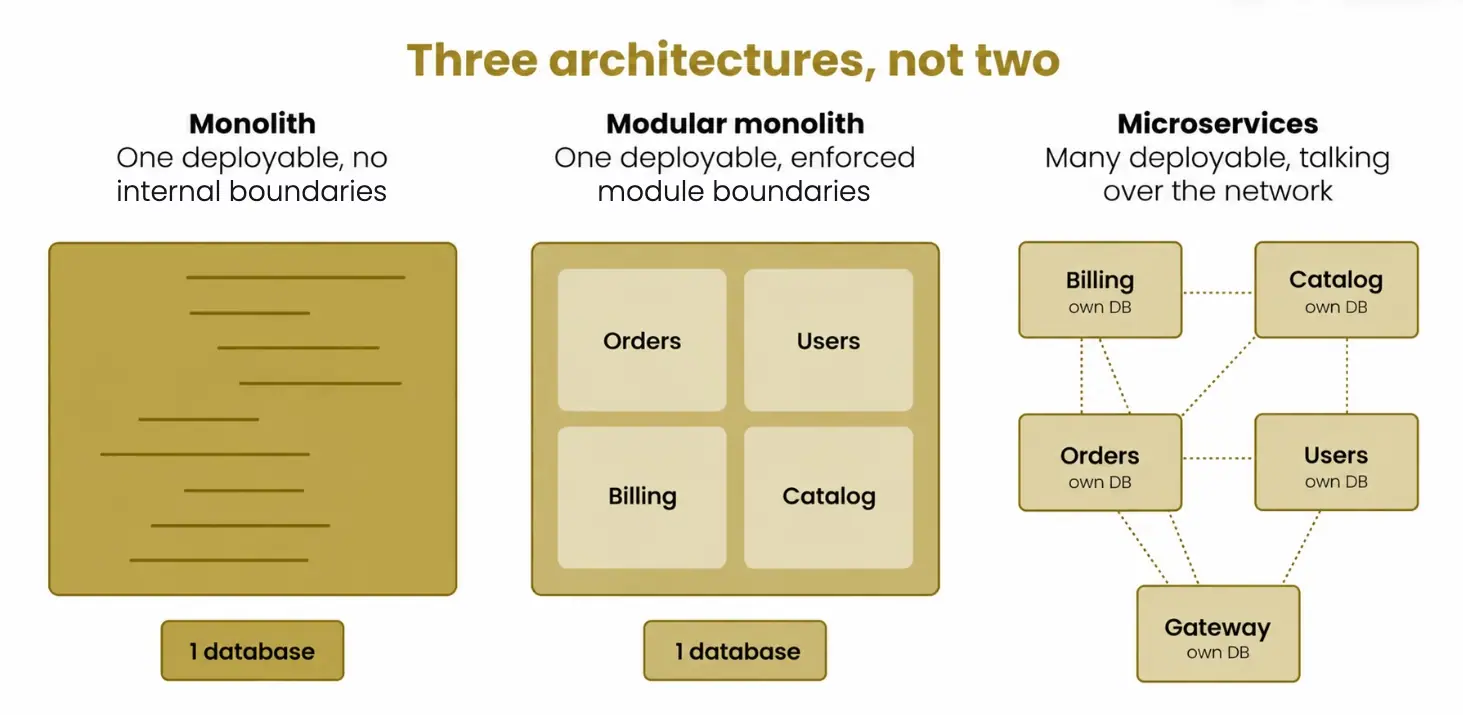
At a glance
| Monolith | Modular monolith | Microservices | |
|---|---|---|---|
| Deployable units | One | One | Many |
| Internal boundaries | Weak or none | Enforced in code | Enforced by the network |
| Communication | In-process calls | In-process calls through interfaces | Network calls (HTTP, gRPC, queues) |
| Data | Shared database | Shared database, module-owned tables | Database per service |
| Operational overhead | Low | Low | High |
| Independent scaling | Whole app | Whole app | Per service |
| Best fit | Early products, small teams | Growing products and teams | Large orgs with many autonomous teams |
How we got here: the rise of microservices
Microservices did not become popular by accident. They solved real problems for a specific kind of company.
The origin story
In March 2014, James Lewis and Martin Fowler published their widely cited article Microservices, describing the style as "an approach to developing a single application as a suite of small services." It gave a name to patterns that Netflix, Amazon and others had been using to scale both their systems and their engineering organizations.
The pitch was compelling. Small services meant small teams could own them end to end, deploy them independently and pick the right tool for each job. Cloud platforms, containers and Kubernetes then made it cheaper than ever to run many services.
Conway's Law did the rest
In 1968, Melvin Conway observed that organizations "are constrained to produce designs which are copies of the communication structures of these organizations." Microservices are, at their core, an organizational tool: they let hundreds of engineers work in parallel without stepping on each other.
That is exactly why they work so well at Netflix scale, and why they often struggle at the scale of a 15-person startup.
Adoption outran results
By 2020, an O'Reilly survey of 1,502 practitioners found that about 77% of respondents' organizations had adopted microservices. Yet fewer than 10% reported "complete success," and only around 55% called their results at least "mostly successful." Complexity was the most cited challenge, named by 56% of respondents.
In other words, the industry adopted the architecture much faster than it learned when to use it.
"You shouldn't start a new project with microservices, even if you're sure your application will be big enough to make it worthwhile." — Martin Fowler, MonolithFirst (2015)
The hidden costs of microservices
The benefits of microservices are easy to put on a slide. The costs show up later, spread across infrastructure bills, on-call rotations and slower feature delivery. Martin Fowler's Microservice Trade-Offs groups them into three areas: distribution, eventual consistency and operational complexity.
1. The network is now part of your application
In a monolith, one module calls another with a function call that takes nanoseconds and never fails because of the network. In microservices, the same interaction becomes a remote call. As Fowler puts it, "remote calls are slow and are always at risk of failure."
Every call now needs timeouts, retries, circuit breakers, serialization and versioned contracts. A single user request can fan out across many services, and the slowest one sets the response time.
2. Data consistency gets hard
When each service owns its own database, a business operation that touches several services can no longer rely on a single transaction. Teams turn to patterns like sagas, outbox tables and event sourcing. These are powerful, but they add design work, testing effort and new classes of bugs where data is temporarily out of sync.
3. Operations multiply
Each service needs its own pipeline, monitoring, alerting, logging, secrets, scaling rules and security patches. You now need distributed tracing just to answer "why is this page slow?" Fowler notes that "you need a mature operations team to manage lots of services."
4. Cognitive load on every engineer
A new developer joining a monolith can clone one repository, run it locally and step through a request in a debugger. In a large microservices estate, the same task may require spinning up a dozen services, mocking others, and understanding several deployment environments. Onboarding slows, and senior engineers spend more time explaining the system than improving it.
5. The cloud bill
More services mean more always-on compute, more load balancers, more data transfer between components and more observability tooling, much of it priced per host or per gigabyte. These costs rarely appear in the original migration plan.
6. The distributed monolith trap
The worst outcome is getting the costs of microservices without the benefits. If services share a database, must be deployed together or call each other synchronously in long chains, you have built a distributed monolith: all the coupling of a monolith, plus network latency and failure modes on top.
Real-world case studies: teams that chose simpler
The strongest argument for simpler architecture comes from companies with every resource to do the opposite.
Amazon Prime Video: 90% lower costs
In March 2023, Prime Video's Video Quality Analysis team described how they rebuilt their audio and video monitoring service. The original version used distributed components orchestrated by AWS Step Functions and AWS Lambda. It hit a hard scaling limit at around 5% of the expected load, and passing data between components made scaling to thousands of streams prohibitively expensive.
The team consolidated all components into a single process running on Amazon EC2 and Amazon ECS. The result: infrastructure costs dropped by 90%.
The author, Marcin Kolny, was careful to note that the choice should be made case by case. That nuance is the point: even inside Amazon, the company most associated with service-oriented architecture, the right answer for this workload was a simpler one.
Segment: from 140+ services back to one
Segment (now part of Twilio) routes customer data to over a hundred partner APIs. Its engineers originally gave each destination its own service and repository. As the company added roughly three destinations a month, the architecture grew to more than 140 services (Goodbye Microservices, Alexandra Noonan, 2018).
The outcome was the opposite of what microservices promise. Three full-time engineers spent most of their time just keeping the system running, velocity dropped and defect rates rose. Shared libraries drifted across 140 repos.
After consolidating into a single service and a monorepo:
- The test suite for all destinations went from up to an hour to milliseconds
- Shared library improvements rose from 32 to 46 in the following year
- One engineer could deploy in minutes instead of deploying 140+ services
- A shared worker pool absorbed load spikes, so small destinations stopped paging on-call engineers
Segment was also candid about the trade-offs: fault isolation got harder, and a bad dependency upgrade can now affect many destinations at once.
Shopify: a modular monolith at massive scale
Shopify runs one of the largest Ruby on Rails applications in the world. In 2020 its core monolith held more than 2.8 million lines of Ruby and 500,000 commits, with hundreds of developers shipping to it (Under Deconstruction: The State of Shopify's Monolith, Philip Müller).
Rather than splitting it into microservices, Shopify divided the monolith into 37 components with clear owners, and built Packwerk, an open source static analysis tool that flags code reaching across boundaries. The stated goal is that "developers should feel like they are working on a much smaller app than they actually are." Shopify still extracts separate services where there is a clear need, such as storefront rendering and credit card vaulting.
Stack Overflow: global scale on a handful of servers
Stack Overflow has long been the classic counterexample. In 2016, the Q&A network served about 66 million page loads a day using 11 IIS web servers and 4 SQL Servers. Its main application is a multi-tenant monolith, and engineer Nick Craver wrote that the team "can run the entire Q&A network off of a single application pool on a single server" (Stack Overflow: The Architecture, 2016 Edition).
Basecamp and 37signals: simplicity as a business model
37signals, maker of Basecamp and HEY, has built its products as Rails monoliths for two decades and argues openly for what co-founder David Heinemeier Hansson calls "the majestic monolith." The same philosophy extends to infrastructure: in 2023 the company finished moving seven applications off the public cloud onto its own hardware, projecting savings of at least $1.5 million per year against a 2022 cloud budget of $3.2 million, without growing its operations team (We have left the cloud).
The pattern across all five
| Company | Starting point | What they did | Reported result |
|---|---|---|---|
| Amazon Prime Video | Distributed Step Functions + Lambda | Consolidated into a single process | 90% lower infrastructure cost |
| Segment | 140+ microservices | Merged into one service and monorepo | Tests from ~1 hour to milliseconds; one-engineer deploys |
| Shopify | Large Rails monolith | Modularized into 37 components | Hundreds of developers on one codebase |
| Stack Overflow | Monolith from day one | Kept it, optimized hardware and code | ~66M page loads/day on 11 web servers (2016) |
| 37signals | Rails monoliths | Kept them, simplified infrastructure | Projected $1.5M+/year savings |
Why simpler architecture is a competitive advantage
Architecture is not just a technical decision. It shapes how fast you ship, how much you spend and who you can hire. For most growing software companies, simplicity wins on all three.
Speed to market
Early-stage and growth-stage companies win by learning faster than competitors. A monolith lets a small team change a feature end to end in one pull request, run the whole test suite locally and deploy once. There are no API contracts to version across teams and no coordinated releases of five services for one feature.
Fowler's core argument in MonolithFirst is that you rarely know your correct service boundaries at the start. Refactoring inside a monolith is cheap; moving a boundary between two deployed services is expensive. Simpler architecture keeps your options open while the product is still finding its shape.
Lower total cost of ownership
Prime Video's 90% cost reduction is an extreme example, but the direction is common. Fewer moving parts mean fewer hosts, less inter-service traffic, less observability tooling and fewer hours spent on platform work. That money and time can go back into the product.
Smaller teams can do more
Segment needed three full-time engineers just to keep 140+ services healthy. After consolidation, a single engineer could deploy the whole system in minutes. When your architecture demands less operational attention, every engineer spends more time on work customers actually notice.
Easier hiring and onboarding
The market for engineers who are productive in complex distributed systems (Kubernetes, service meshes, event streaming, distributed tracing) is competitive and expensive. A well-structured monolith on a mainstream stack lets you hire strong product engineers and get them shipping in days instead of weeks.
Reliability you can reason about
Fewer network hops mean fewer partial failures, fewer timeouts and fewer 3 a.m. pages that start with "which service is it?" A system the whole team understands is a system the whole team can fix.
Focus on what differentiates you
Your customers do not pay for your service mesh. Every hour spent on infrastructure plumbing is an hour not spent on the features, integrations and experience that set you apart. Simpler architecture is a way of spending your engineering budget where it compounds.
When microservices do make sense
None of this means microservices are a mistake. They are a tool with a specific job, and for the right organization they are the correct choice. Fowler's trade-offs list three real benefits: strong module boundaries, independent deployment and technology diversity.
Microservices tend to pay off when several of these are true:
- Many autonomous teams. You have enough engineers (often many dozens or more) that coordinating releases in one codebase has become the bottleneck.
- Very different scaling profiles. One part of the system, such as video encoding, search or a real-time pricing engine, needs far more resources than the rest, and scaling the whole app for it is wasteful.
- Different reliability or compliance needs. A payments or card vault component needs stricter isolation, as with the services Shopify extracts from its monolith.
- Genuinely different technology needs. A machine learning pipeline in Python next to a transactional core in Java or Ruby.
- Mature platform capabilities. You already have automated CI/CD, observability, and an operations or platform team, which Fowler describes as a prerequisite.
If you cannot check most of those boxes, microservices are likely to cost more than they return.
Warning signs you adopted them too early
- Most features require changes to several services at once
- Services share a database or must be deployed together
- More engineering time goes to infrastructure than to product
- Local development requires running or mocking a large part of the system
- Nobody can draw the full request flow from memory
The middle path: start modular, extract when it hurts
For most companies the best answer is not "monolith forever" or "microservices from day one." It is a modular monolith that can evolve. Fowler suggests teams can build a monolith first and peel off services gradually as boundaries become clear, and Shopify shows the approach working with hundreds of developers.
How to build a modular monolith that lasts
- Organize by business domain, not technical layer. Group code into modules like Billing, Catalog and Orders instead of controllers, services and models.
- Give every module a public interface. Other modules call that interface only, never internal classes or tables.
- Enforce boundaries with tooling. Tools like Shopify's Packwerk, ArchUnit for Java or dependency rules in your build catch violations in pull requests.
- Let each module own its data. Even in one database, keep tables owned by one module and avoid cross-module joins.
- Prefer events for cross-module side effects. Publishing "OrderPlaced" in-process makes later extraction to a real message bus far easier.
- Measure before you split. Extract a service only when you can name the specific pain it solves: a scaling hotspot, an isolation requirement or a team bottleneck.
A simple decision framework
Ask these questions in order. The first "no" usually tells you to stay simpler for now.
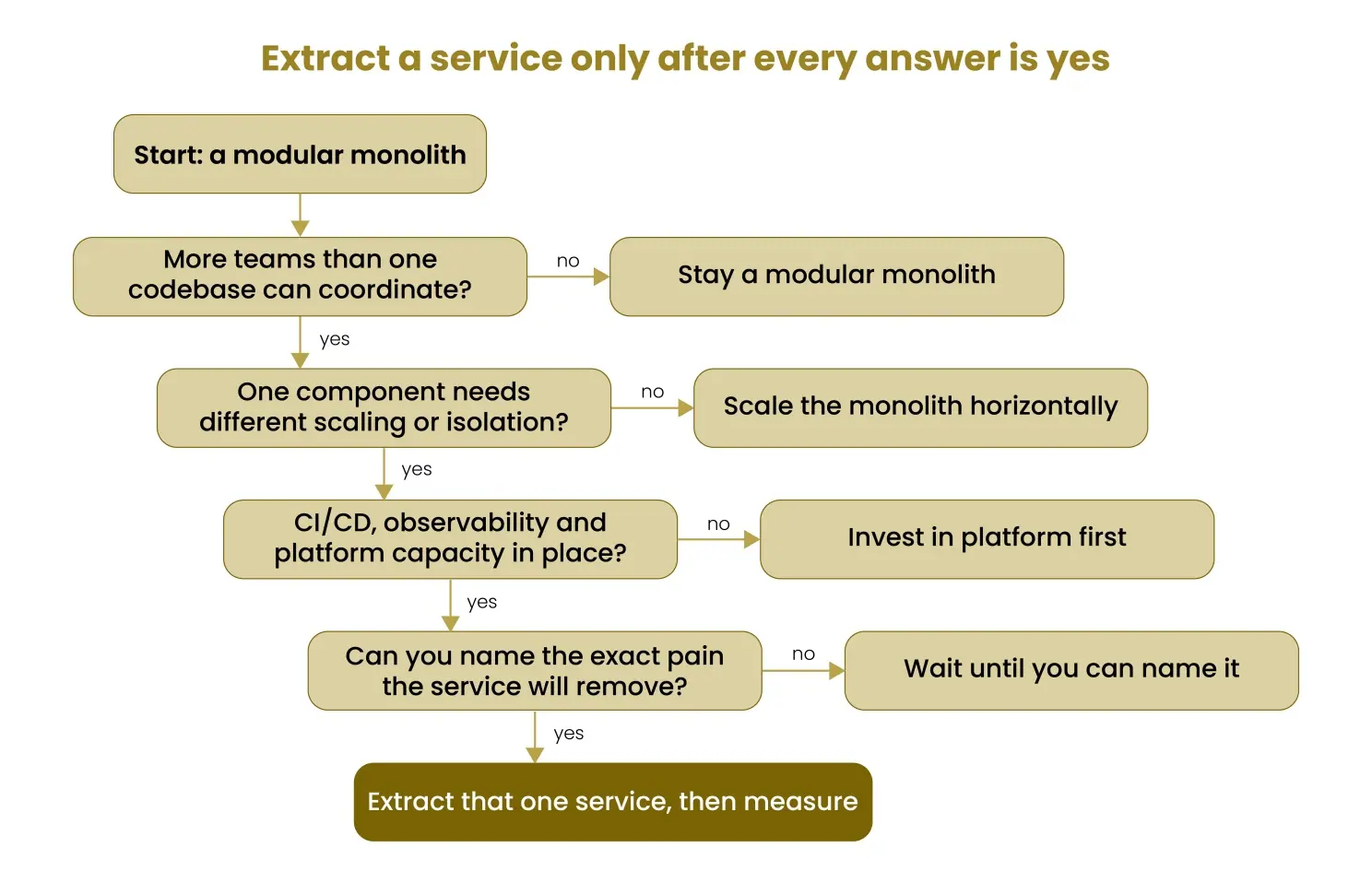
Each "no" points to a simpler, cheaper move that solves today's problem without adding a new service.
| Question | If yes | If no |
|---|---|---|
| Do you have more teams than one codebase can coordinate? | Consider service boundaries per team | Stay with a modular monolith |
| Does one component need very different scaling or isolation? | Extract that one component | Scale the monolith horizontally |
| Do you have automated CI/CD, observability and platform capacity? | You can run services safely | Invest in platform first |
| Can you name the exact pain the new service will remove? | Extract it, and measure the result | Wait until you can name the result |
Conclusion: simplicity is a strategy, not a compromise
Microservices solve an organizational scaling problem. If you do not have that problem yet, adopting them early means paying for complexity you cannot use. The evidence from Amazon Prime Video, Segment, Shopify, Stack Overflow and 37signals points the same way: simpler architecture often ships faster, costs less and is easier to run.
The competitive advantage goes to teams that match their architecture to their actual stage, keep their codebase modular and extract services deliberately, when the data says it is time.
How CodingBand can help
At CodingBand, we connect US and Canadian tech companies with senior engineers from Latin America who have built and run systems on both sides of this debate. Whether you need to untangle a distributed monolith, modularize a growing codebase or extract a high-scale service the right way, our nearshore engineers work in your time zone and integrate directly with your team.
Want a second opinion on your architecture? Talk to CodingBand about building the team that keeps your system as simple as it can be, and no simpler.
Originally published on LinkedIn.