How Prompt Engineering is different from Context Engineering
It all started with Prompt Engineering — the golden child of early GPT-3 hype. Everyone was suddenly a "prompt engineer," which mostly meant typing weird things into a chat box and taking screenshots when the model wrote something impressive.
Then came Context Engineering, which sounds like Prompt Engineering's boring cousin, until you realize it's what makes everything actually work at scale.
What we'll review
- What are they, really?
- Purpose of each one
- Use cases
- Is one a subset of the other?
- Relationship between the two
- Consequences of doing it poorly
- Final thoughts
1. What are they, really?
Prompt Engineering
You write something clever in a prompt box, hoping the model "gets it." It's designing one-shot instructions: "You are an expert X. Do Y like Z."
You just write clearly, manage all the instructions, take care of the format, add a few examples and hit PLAY.
It's how we survived before tools like memory, embeddings, retrieval and function-calling showed up. Still super useful — especially for creative tasks or one-off conversations.
Context Engineering
This is deeper. You're not just writing a prompt. You're designing the entire mental world the model operates in.
It's about what the model sees (docs, past chats, examples, summaries), how it sees it (structured or messy), and when it sees it (dynamically injected, static, memory-based). You're thinking tokens, not just instructions. System prompts. Memory slots. Tool outputs. History windows.
Context Engineering doesn't stop at prompt design — it frames the whole conversation.
2. Purpose
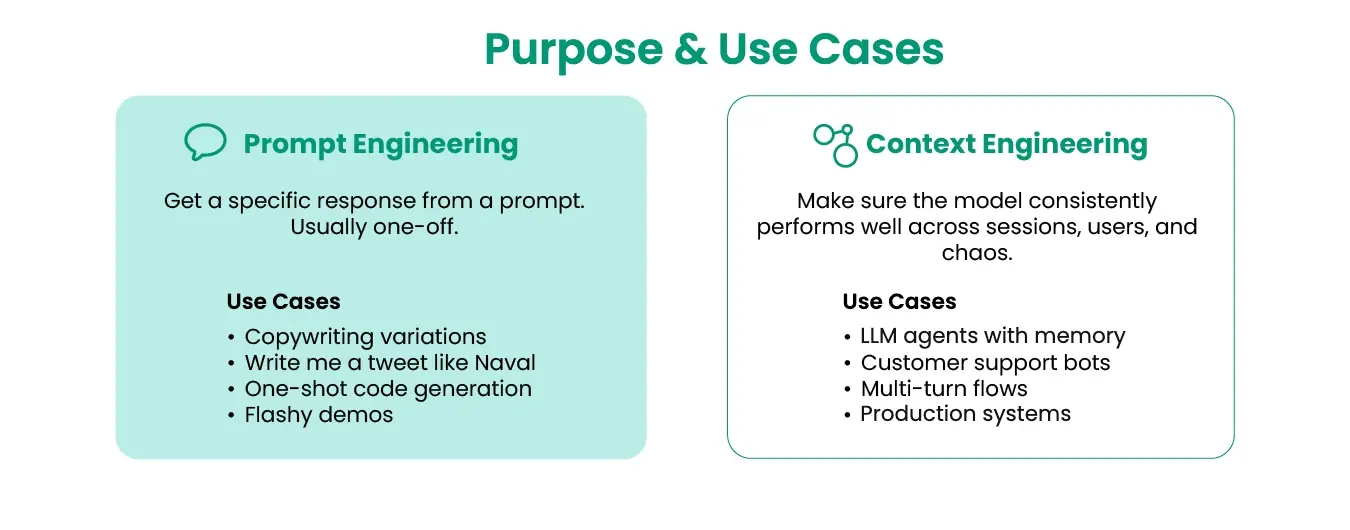
- Prompt Engineering: get a specific response from a prompt. Usually one-off.
- Context Engineering: make sure the model consistently performs well across sessions, users, and chaos.
3. Use cases
- Prompt Engineering: copywriting variations, "write me a tweet like Naval", one-shot code generation, flashy demos.
- Context Engineering: LLM agents with memory, customer support bots that don't hallucinate, multi-turn flows, production systems that need predictability.
4. Is one a subset of the other?
Yes. But not the way people usually assume.
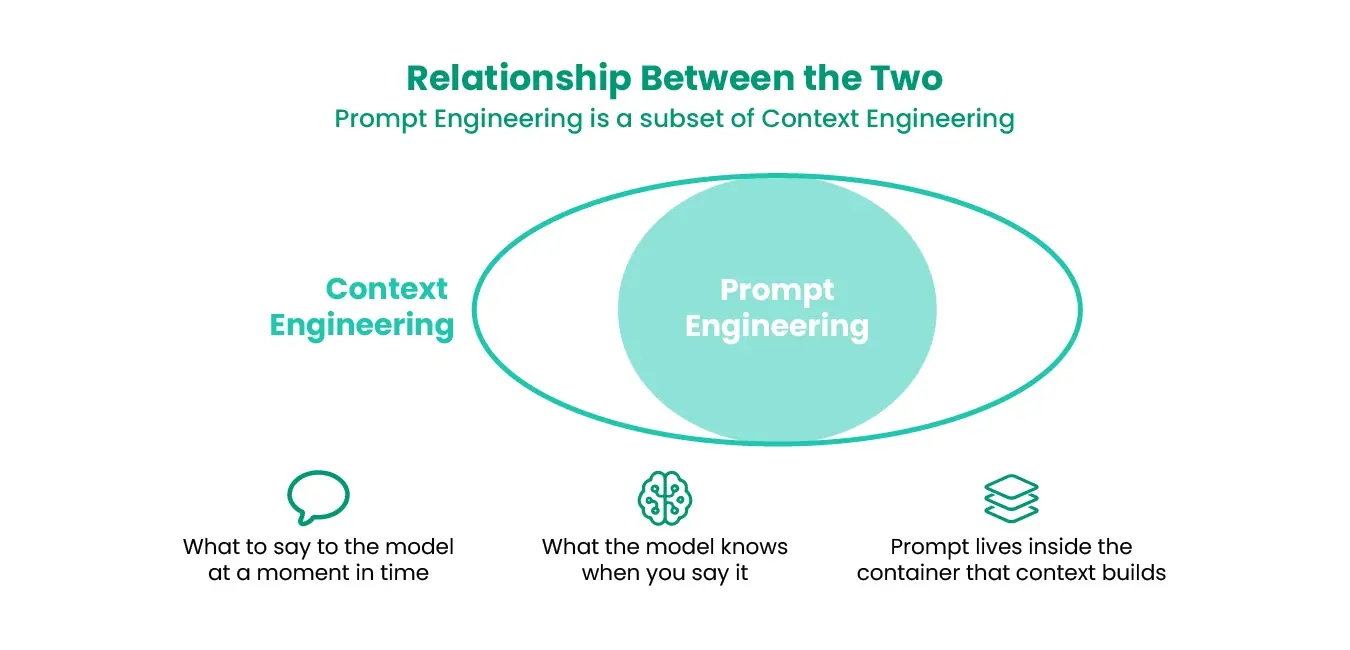
Prompt Engineering is a subset of Context Engineering, not the other way around.
Think of it like this:
- Prompt Engineering focuses on what to say to the model at a moment in time.
- Context Engineering focuses on what the model knows when you say it — and why it should care.
If Prompt Engineering is writing a brilliant instruction… Context Engineering is deciding what happens before and after that instruction — what's remembered, what's pulled from memory or tools, how the whole thing's framed.
So no, these aren't competing practices.
Prompt Engineering is one small part of the much bigger machine that Context Engineering builds.
5. Relationship between the two
Prompt Engineering is what you do inside the context window. Context Engineering is how you decide what fills the window.
You can engineer a killer prompt. But if it gets buried behind 6K tokens of irrelevant chat history or poorly formatted retrieved docs? Game over.
6. Consequences of doing it poorly
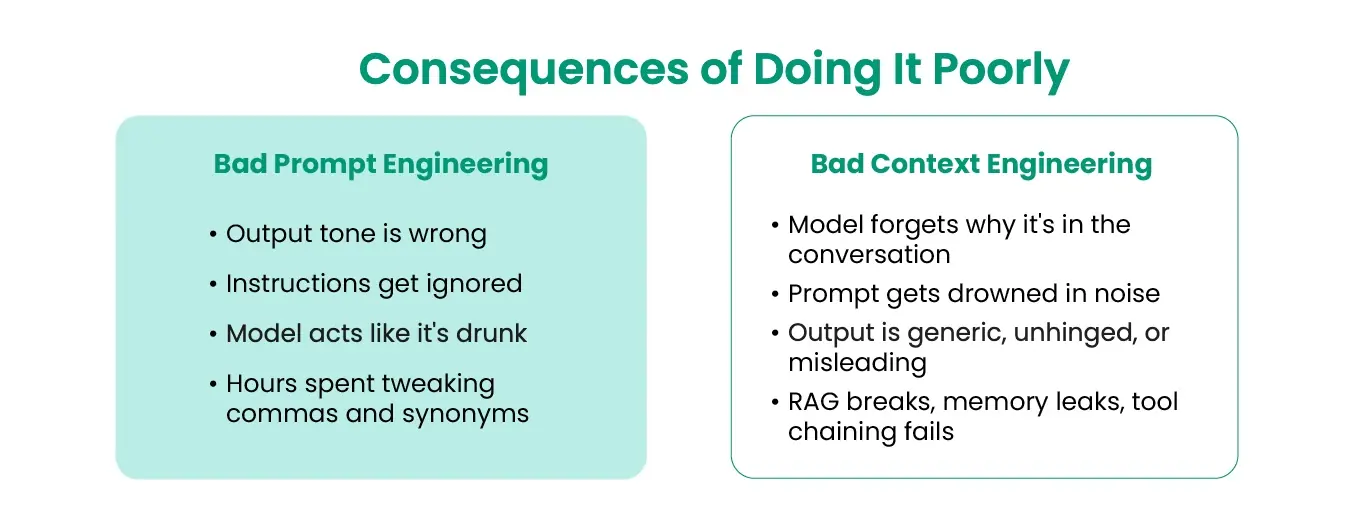
Bad Prompt Engineering:
- Output tone is wrong
- Instructions get ignored
- Model acts like it's drunk
- You spend hours tweaking commas and synonyms
Bad Context Engineering:
- Model forgets why it's even in the conversation
- Prompt gets drowned in noise
- Output is generic, unhinged, or misleading
- RAG breaks, memory leaks, tool chaining fails
7. Final thoughts
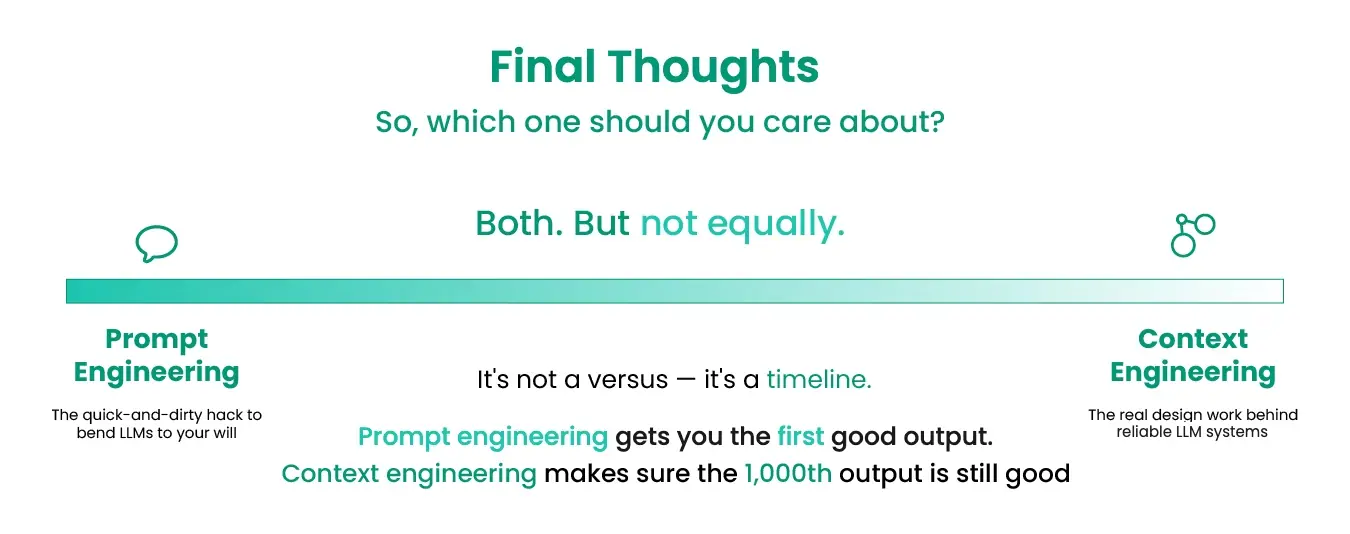
Both. But not equally.
- Prompt Engineering is how we started. It's the quick-and-dirty hack to bend LLMs to your will.
- Context Engineering is how we scale. It's the real design work behind reliable LLM-powered systems.
Prompt engineering gets you the first good output. Context engineering makes sure the 1,000th output is still good.
Originally published on LinkedIn.