
Reflecting on last week's deep dive into software estimation principles, I believe these are the most reliable guidelines to consider when approaching software estimation. Here's a brief summary of what we've covered so far.
- Clarify requirements. The cone of uncertainty describes how estimation accuracy improves as a project progresses. Research shows that well-defined requirements enhance estimation accuracy by 2.75 times. While designing architecture or analyzing the codebase can help, their impact on accuracy is minimal in comparison.
- Define the Definition of Done (DoD). The DoD establishes the criteria a Product Backlog Item (PBI) must meet for completion. It ensures that quality assurance steps — such as unit testing and approval — are consistently followed. Without a clear DoD, teams may overlook essential QA processes, produce inconsistent results, and underestimate effort.
- Avoid perfection. Estimation is an informed best guess, not a rigid deadline. Many people mistakenly treat estimates as fixed commitments, leading to unrealistic expectations. Instead of aiming for perfection, teams should refine estimation accuracy over time (e.g., through iterative sprints) and use techniques like 3-point estimation to account for uncertainty.
- Leverage collective knowledge. Group-based estimation is generally more reliable than individual estimates. Collaboration helps identify overlooked aspects, offers multiple perspectives, and reduces bias, ultimately improving accuracy.
Ready for more? Let's take a look at what else we need to cover to have a precise software estimation.
Principle 5: No story points estimation
This is the most controversial topic: don't estimate with story points.
One of the main arguments for using story points is that they abstract estimation. Given the uncertainties in software development, estimating in hours or days can often be impractical or meaningless. However, uncertainty is not unique to software development — industries like design, transportation, construction, and entertainment also face unpredictability. In fact, creative fields such as design often deal with even greater uncertainty, yet none of these industries rely on story points.
The primary reason I don't support story points is that they don't aid decision-making. As mentioned earlier, estimation helps determine the next course of action. That's why everyone — not just business stakeholders but also development teams — wants a clear estimation. Imagine asking a designer how long it will take to create a specific feature, and they respond, "The estimate is 20 points." What can you do with that information? It doesn't provide any actionable insight or help determine the next steps.
Actually, if you calculate how many story points are consumed in each Sprint, you can estimate with story points. For example, this user story is estimated at 8 points and our average velocity is 50 points, so we can finish it within the upcoming Sprint. However, it requires calculation, takes time, is not a simple, intuitive, and universal unit, and doesn't enhance collaboration between businesspeople and software engineers, which is one of the principles of Agile. It just causes confusion in the organization.
Instead, you should use universal units like hours, days, or weeks. Businesspeople, designers, software engineers, salespeople, and testers can understand them intuitively.
Principle 6: Rough estimation works
The sixth principle is that rough estimation works. In most cases, businesspeople ask you for a rough estimation when they share their ideas, before you define requirements (requirement definition is the first and foremost important thing for estimation, as explained in Principle 1). The right action is to give a rough estimation while emphasizing that it is rough and must be revised later, because it helps businesspeople make decisions. No one gets angry when you change it later.
Imagine that you take a taxi, and the driver says, "I don't know how long it takes," or "It takes 30 minutes to an hour." The former doesn't help you at all, while the latter helps you decide whether to take a taxi or public transportation. This is the reason most ridesharing services display a rough estimation of how long it takes to get to a destination, even though it's not really precise. Transportation is also one of the hardest industries to estimate because of many factors such as weather, events, local rules, accidents, construction, etc.
However, there is an exception. You shouldn't give a rough estimate when you work as a subcontractor and your client hasn't paid. As estimation is critical information and requires a lot of effort, many people try to extract it by pretending to be potential clients. In such cases, you should use it as a bargaining chip and think carefully about whether and when to share it. When working in a software subcontractor company, I saw many people asking, "Please tell me only the estimation," and I was never paid.
Principle 7: Make it small
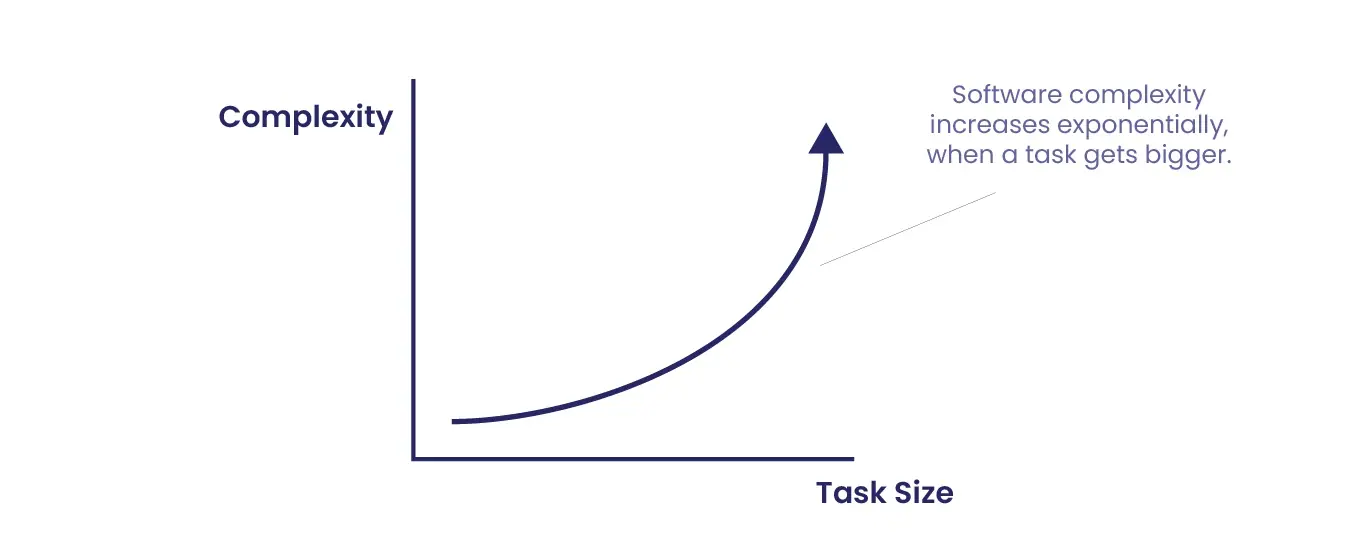
A small task makes the estimation easier and more accurate. One of the best practices of Agile is to make a task (user story) small enough to be completed within a Sprint, which is commonly 1 or 2 weeks and must not be more than a month. That's because software complexity increases exponentially, not linearly, when a task gets bigger.
For example, estimating what you build for the next week is much easier than estimating what you build for the next year. The smaller the task is, the more accurate the estimation will be. If you find your project's tasks too big, they should be broken down into smaller tasks that can be completed in a few weeks. This practice can be applied not only to Agile but also to waterfall.
In addition to estimation accuracy, a small task increases quality and performance, because small development, testing, and releases make it easier to debug, identify affected areas, and reduce lead time. This is a best practice of DevOps: small and frequent releases are one of the critical factors in increasing corporate revenue. The more frequently software projects deploy small features, the more revenue the organization gains.
Principle 8: Make it independent
An independent task improves the estimation. Dependency is one of the biggest challenges in software development, as it is difficult to identify and increases programming complexity.
An independent task (a user story) means that it can be completed and released without working on or waiting for other tasks. When you can release it independently, it has the highest independence. Although it's impossible to eliminate all dependencies, you should put effort into isolating a task from others as much as possible.
For isolation, you should know the techniques and patterns of user story splitting. The first rule is to clarify acceptance criteria, which are detailed requirements that must be met before completion. When you clarify them, you know what you should split into other user stories.
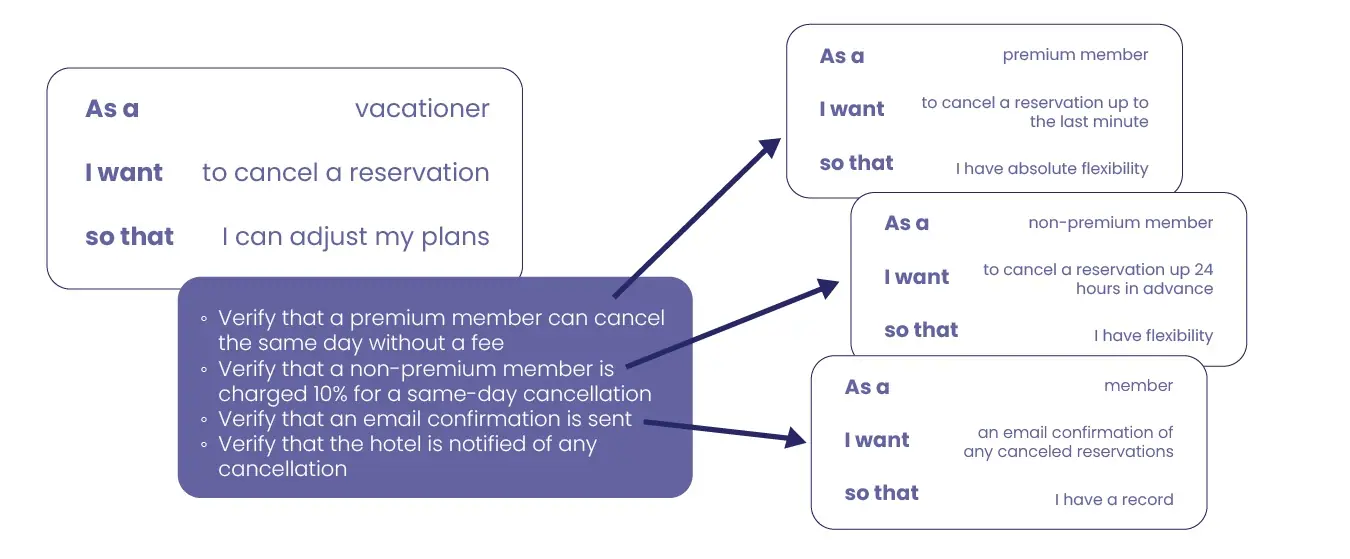
The second rule is to know some patterns of user story splitting. For example, splitting with CRUD (Create, Read, Update, and Delete) is one of the patterns. An example is below.
As a user, I want to manage my account and personal information.
- I can read my account information.
- I can create my account.
- I can edit my account information.
- I can delete my account and information.
Principle 9: Spike it!
A Spike, one of the practices of Agile, is a small, time-boxed investigation into feasibility, uncertainty, and risk. If you do not have enough information to estimate, you should conduct a Spike.
There are two types of Spikes: business and technical. A business Spike clarifies requirements. As mentioned earlier, clear requirements are the most critical factor for estimation; if you are not sure about them, you should conduct a business Spike. A technical Spike researches technology. For example, when you use a new technology, you conduct a technical Spike to check its feasibility and uncertainty.
A Spike must have a single goal and be time-boxed. When you conduct one, set the goal you want to clarify and time-box it to prevent it from being drawn out.
Principle 10: Daily Scrum
The final principle is to conduct a Daily Scrum. The Daily Scrum is one of the official Scrum Events, held at the same time and in the same place every working day. During the Daily Scrum, everyone on the team answers three questions:
- What did I do yesterday?
- What will I do today?
- What impediments hold me back from achieving the goal?
Even if you practice all the principles explained earlier, unexpected events and troubles inevitably occur daily, so you should check your progress daily (not weekly or monthly). An important customer may suddenly request an urgent feature with a deadline. Because of a lack of skills, a developer may not make enough progress. A third-party tool may change its terms of service. Risks and uncertainties are numerous in software projects, so you should check progress and raise problems on a daily basis.
I believe the Daily Scrum is the most important meeting because it is the opportunity to solve small problems early. For example, if a developer has a technical problem, they can ask several developers for help. The technical problem may require requirement changes; in that case, they can discuss it with the product owner at the same time.
Bad news must emerge as soon as possible. It's human nature not to want to hear or discuss bad news, and to want to hear that "everything is going smoothly." However, software development doesn't work like this, and troubles are inevitable. The key is to detect small problems as early as possible, before they grow to unmanageable levels.
Originally published on LinkedIn.