How to significantly improve software estimation based on practical experience and science
Software development is full of uncertainties and unpredictabilities. Business requirements frequently change, and new technologies emerge daily. In such a fast-changing environment, estimation is one of the most difficult activities of software development.
We can use experience supported with science to progress in the way we estimate. Let's take a look.
Why is estimation important?
I must start with why. Why is estimation important? Why do customers, executives, salespeople, and stakeholders always ask, "How long does it take?" "When will you finish it?" What do they do based on the estimation? The answer is really simple: decision-making. The ultimate purpose of estimation is to decide what to do next based on that information.
Estimation highly and directly impacts time and cost, which businesspeople care about for ROI (Return on Investment). The reason for estimation is not to reduce risks, improve velocity, or ensure quality but to support decision-making. If estimation doesn't help businesspeople in deciding on the next action, estimation is worthless.
The project management triangle explains that there are three constraints in project management: scope, resources, and time. For example, if the scope is too large to meet the deadline, the deadline (time) may be extended, or more people (resources) may be added to the team. If the deadline is critical, the scope will be reduced. Estimation (time) is one of the key factors in decision-making.
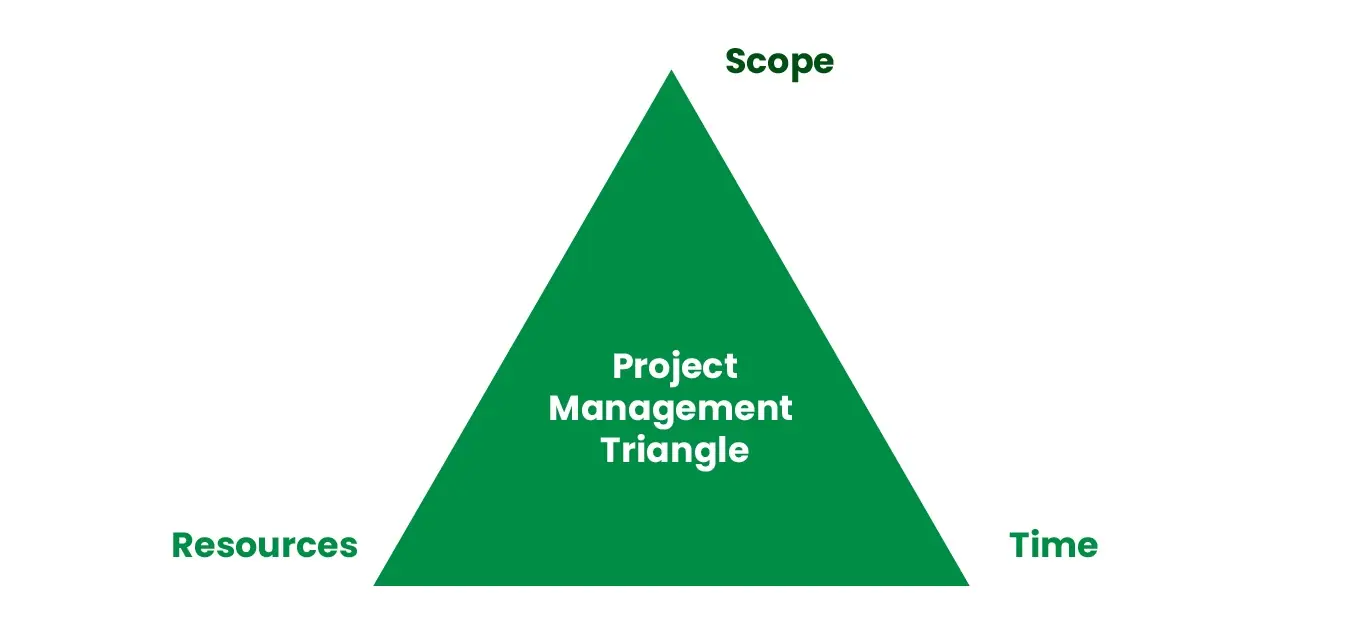
The project management triangle described "quality" as one of the factors. Time, cost, and resources expand when you increase quality. However, quality must be frozen in software development, meaning it must be consistently high and not considered in decision-making.
If a customer finds defects, a business loses customer trust and reputation, makes reports, investigates them, has more internal and external communications, and develops and tests the system again. There are numerous hidden costs.
Principle 1: Clarify requirements
The cone of uncertainty describes the relationship between the stage of development and estimation. The basic concept is that estimation accuracy increases as development progresses. In the diagram below, the vertical line describes the estimation variability, while the horizontal line is the timeline (stage of development). The shaded area illustrates the size of the estimation error. As you can see, estimation error narrows as it goes right.
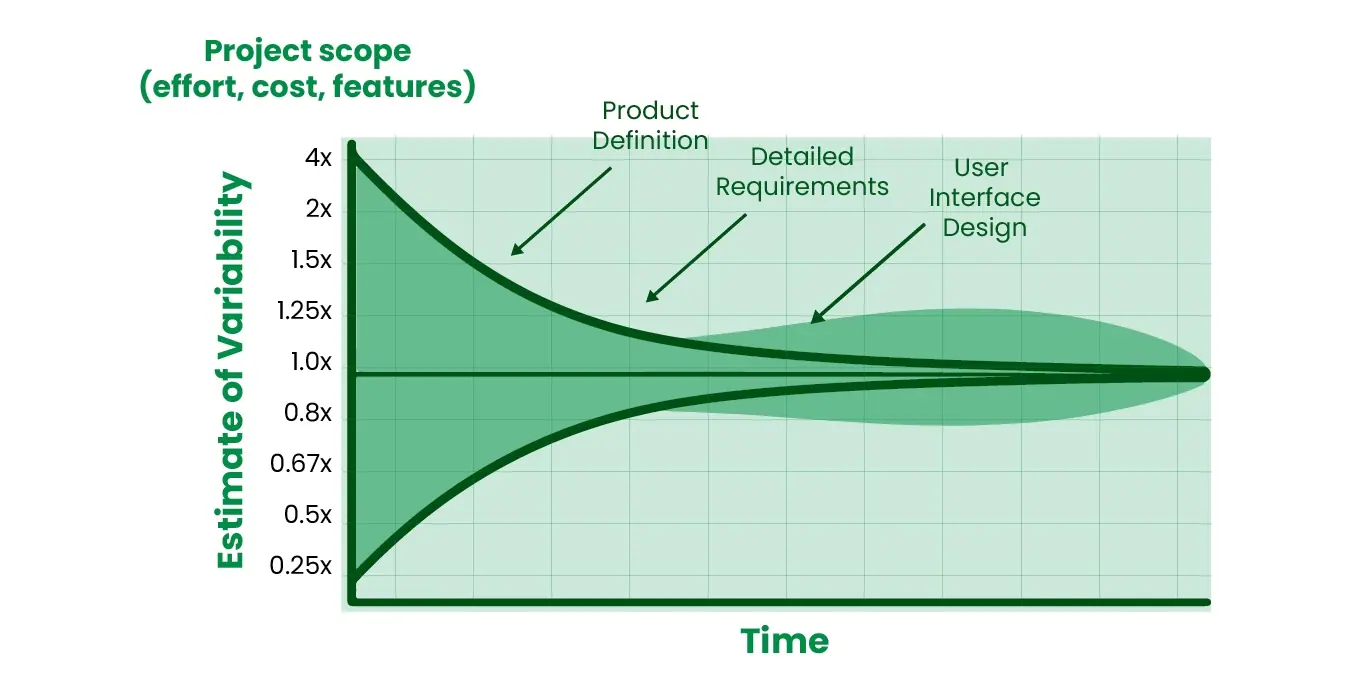
There are two types of errors in estimation: overestimation and underestimation. In the diagram, the upper side is overestimation, and the lower side is underestimation. The maximum errors on both sides are 4 times. At the very beginning of the project, the estimation would be wrong 4 times (400%) either way. For example, a feature you estimate to take a month would actually take 4 months.
The key point here is that the requirement definition is the most important stage for estimation. As you can see, a significant narrowing of the cone occurs during product definition, detailed requirements, and user interface design, leading to around 275% better accuracy (2.75 times). Even if you conduct software design or research on the codebase, the improvement is tiny. Designing architecture improves it by only 25% (0.25 times), and coding does by just 10% (0.1 times).
Principle 2: Define the Definition of Done (DoD)
The second principle is to define the DoD, which is a standard of how a PBI (Product Backlog Item, also called ticket, task, or issue) must be completed in a team. For example, newly developed code must be reviewed by two software engineers before a user story is completed. The DoD clarifies the workflow, ensures quality, and improves performance.
The DoD is critical for estimation because it clarifies the quality assurance step. As explained earlier, the quality must be frozen and consistently high for performance. This is implemented with the DoD.
Without the DoD, output quality will be inconsistent. For example, some software engineers don't write unit tests and E2E automation tests. Some user stories are approved by a product owner, whereas some others are not. These processes highly affect the estimation. Examples of the DoD are as follows:
- A user story must be reviewed by the Three Amigos: a product owner, a software engineer, and a tester.
- Unit tests must be written and exceed 80% of coverage.
- The new code must be reviewed by two software engineers.
- Acceptance tests must be conducted by a tester.
- The final outcome must be demonstrated to a Product Owner for approval.
The DoD must be defined based on products, meaning that one product has one DoD. Even if you have one product with three teams, the DoD must be one. It is cohesive to a product. And the DoD varies significantly based on products. For example, one product's DoD requires code review by two developers, while another one requires only one developer. The DoD also evolves as the project context changes.
Principle 3: Avoid perfection
The third principle is to avoid perfection, which means that estimation is merely the best guess, not a deadline that the development team must meet, no matter what.
Instead of perfection, you should aim for better accuracy over time, which is called kaizen or continuous improvement. At the end of development, a team reviews how long it actually took, checks the gap between estimated and actual time, shares experience with each other, and makes use of it for the next development.
Principle 4: Collective knowledge
The fourth principle is to use collective knowledge, meaning estimating as a group. The idea behind this is that estimates made by multiple people are more accurate than those made individually because it helps prevent oversight. Relying on a single-person estimate is prone to errors, so having multiple people involved in the estimation process improves accuracy. There are two aspects of collective knowledge.
The first aspect is requirements. As mentioned earlier, clear requirements and scope are the first and foremost important factors in estimation. Overlooking requirements affects estimation and is one of the common errors. Three Amigos is an Agile technique that reviews requirements from different perspectives, which are business, technology, and quality.
- A businessperson should check whether they are valuable and meet users' expectations. Usually, a product owner reviews it in Agile/Scrum.
- A software engineer should check the requirements to assess feasibility and anticipate any technical challenges. Requirements can significantly affect the project's estimation, so it is vital for the developer to review them thoroughly. If there are any difficulties, the developer should raise the alert and consult with the product owner.
- A tester (or QA) should check from the quality point of view. As the tester commonly knows bug patterns, she must point out any oversights and potential bugs.
Continue reading: Principles of Software Estimation (Final Part) covers the last six principles, from dropping story points to the Daily Scrum.
Originally published on LinkedIn.